
Our Blog
Turning Waste Into Sustainable Energy & Value
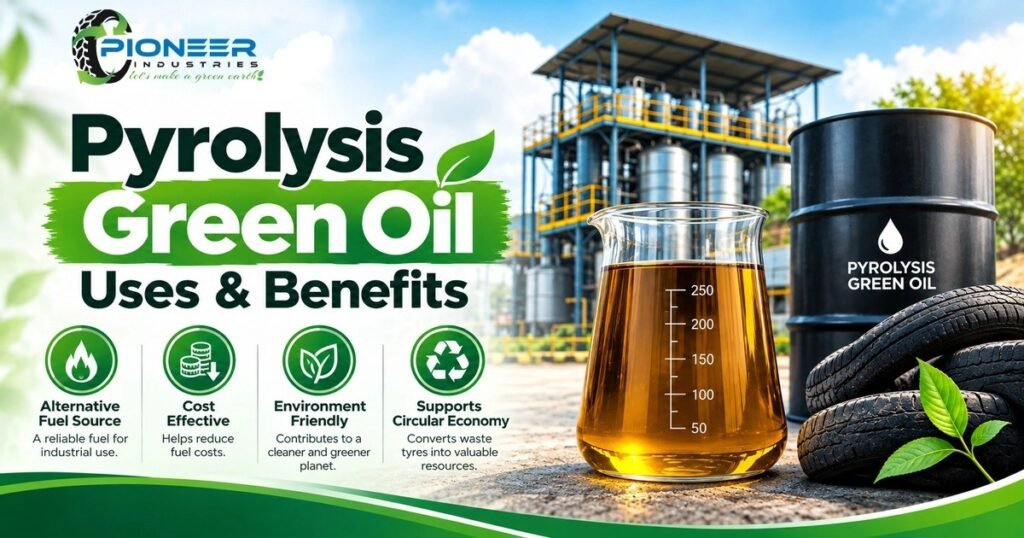
Pyrolysis green oil is an alternative fuel produced by heating end-of-life tires without oxygen until they break down into oil, carbon and gas. In Bangladesh, factories use it in boilers, brick plants, steel workshops and glass units as a lower-sulphur alternative to furnace oil with potential cost savings.
Bangladesh’s industries depend heavily on furnace oil, diesel and coal to run boilers, kilns and furnaces. At the same time, scrap tires and rubber waste are difficult to dispose of safely. Pyrolysis green oil connects these two problems. It turns waste tires into a usable industrial fuel while recovering other valuable materials.
This guide explains what pyrolysis green oil is, how it is made, its key properties, where it is used and what buyers should check before switching. It is written for factory owners, plant managers and procurement teams in Bangladesh. Pioneer Industries Ltd, a Dhaka-based eco-manufacturer, produces pyrolysis green oil as part of its waste-to-energy operations.
What Is Pyrolysis Green Oil?
Pyrolysis green oil is a liquid fuel made by the thermal decomposition of end-of-life tires and rubber waste in a low-oxygen reactor. It is also known as tire pyrolysis oil or pyrolysis oil.
Pioneer Industries Ltd is a Dhaka-based eco-manufacturer of pyrolysis green oil, recovered carbon black and biomass briquettes. Its Pioneer Green Oil is supplied as an alternative fuel for suitable industrial thermal applications.
The word “green” refers to the circular approach. Waste that would otherwise be dumped or burned is recovered as energy. It does not mean the fuel is free of emissions. Like any industrial fuel, it must be stored, handled and burned correctly.
This guide explains what pyrolysis green oil is, how it is made, its key properties, where it is used and what buyers should check before switching. It is written for factory owners, plant managers and procurement teams in Bangladesh. Pioneer Industries Ltd, a Dhaka-based eco-manufacturer, produces pyrolysis green oil as part of its waste-to-energy operations.
How Is Pyrolysis Green Oil Made From Waste Tires?
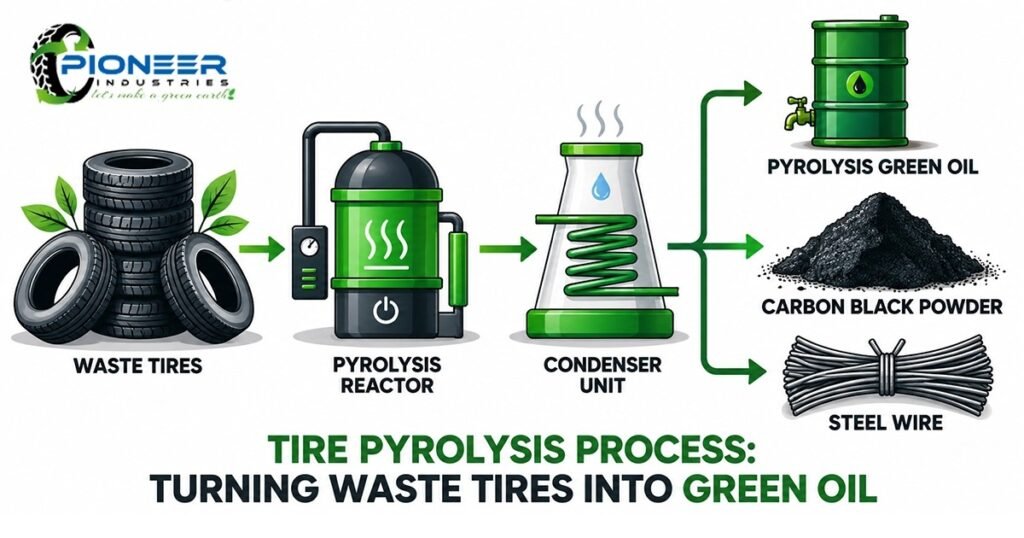
Pyrolysis green oil is made by heating tires in a sealed reactor without oxygen, so the rubber breaks down instead of burning. The resulting vapours are cooled and condensed into oil.
The process generally follows these steps:
- Collection and preparation: end-of-life tires and rubber waste are collected, sorted and prepared for the reactor.
- Heating: the material is heated in a closed reactor with no oxygen present.
- Condensation: vapours are cooled and condensed into liquid oil. Remaining gas can often be reused to help heat the process.
- Separation: solid residue is separated as carbon, and steel wire is removed.
- Refining and storage: the oil is treated and stored before supply to industrial customers.
Pioneer Industries describes its approach as closed-loop pyrolysis with green refining, designed to maximise material recovery. The solid carbon left after pyrolysis is processed into recovered carbon black, a second product line that reduces reliance on virgin material in rubber and industrial manufacturing.
What Are the Key Properties of Pyrolysis Green Oil?
Pyrolysis green oil is judged mainly by calorific value, sulphur, ash, water content and density. Pioneer Green Oil has a typical calorific value of 10,400 ± 3% cal/g, which indicates the heat energy it can deliver.
Typical properties of Pioneer Green Oil:
Calorific value: 10,400 ± 3% cal/g
Density at 15°C: 0.87–0.93 g/cc
Sulphur (total): up to 1% by weight
Ash: up to 0.05% by weight
Water content: up to 0.25% by volume
Appearance: dark / black liquid
Low ash and low water content support cleaner fuel handling and stable energy output. Sulphur of up to 1% compares with up to 4% stated for furnace oil in the reference comparison. These are typical values, so buyers should request the latest batch test report before ordering
What Are the Benefits of Pyrolysis Green Oil?
The main benefits of pyrolysis green oil are strong heating value, lower sulphur than furnace oil, potential cost savings and productive use of waste tires.
- High calorific value: about 10,400 cal/g gives strong energy potential for industrial thermal use.
- Lower sulphur: up to 1% sulphur against up to 4% for furnace oil in the reference comparison.
- Low ash and water: supports cleaner fuel handling and consistent combustion.
- Potential cost savings: reference comparison indicates potential savings of 5–10% against furnace oil and 25–30% against diesel. These are potential savings based on reference comparison, and actual results depend on your equipment and local prices.
- Waste recovery: every batch diverts end-of-life tires from landfill or uncontrolled burning and supports a circular economy.
- Local supply: it is produced by a Bangladesh-based manufacturer, which simplifies sourcing and communication for local buyers.
Where Is Pyrolysis Green Oil Used in Bangladesh Industry?
Pyrolysis green oil is used as a thermal fuel in boilers, brick plants, steel workshops, glass units, power plants and hot mix plants. It suits operations that currently burn furnace oil or diesel.
Boilers and Industrial Heating
Boilers that generate steam or hot water for manufacturing can use pyrolysis green oil as an alternative fuel, subject to burner compatibility. This is relevant to factories with high daily fuel demand.
Brick Plants
Brick plants need sustained high heat. Pyrolysis green oil offers a liquid fuel option with a high calorific value for suitable kiln and firing setups.
Steel Workshops and Glass Units
Furnaces in steel workshops and glass units need steady, high-temperature fuel. Low water content helps maintain the usable energy characteristics of the oil.
Power Plants and Hot Mix Plants
Power plants and hot mix plants for road construction use large volumes of fuel oil. Pyrolysis green oil can be evaluated as a replacement for part of that demand.
In every case, suitability depends on your burner, pumps and operating conditions. A small trial run is the safest first step.

How Does Pyrolysis Green Oil Compare With Furnace Oil and Diesel?
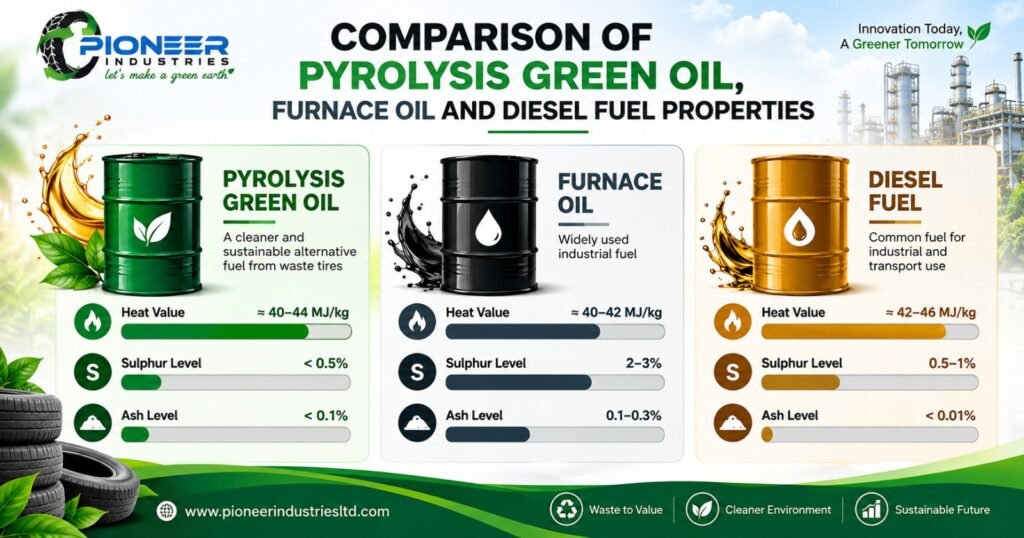
Pyrolysis green oil sits between furnace oil and diesel on most fuel parameters, with lower sulphur than both. The values below are typical figures from a reference comparison.
Its calorific value is slightly above the furnace oil figure and slightly below diesel. Sulphur is lower than both. Ash is lower than furnace oil but higher than diesel. Confirm current values with a batch test report.
What Should Buyers Check Before Switching to Pyrolysis Green Oil?
Before switching, buyers should confirm equipment compatibility, fuel quality, safe storage and regulatory compliance. A structured check avoids downtime and unexpected costs.
- Burner and pump compatibility: confirm that your burner, nozzle, pump and heating system suit the fuel’s density and viscosity.
- Test report: request a recent batch test report and ask about batch-to-batch consistency.
- Trial run: start with a small volume and monitor combustion, flame stability and maintenance needs.
- Storage and handling: use proper tanks, ventilation and fire safety practices for liquid fuel.
- Regulatory compliance: check that your emissions and fuel use meet environmental requirements in Bangladesh. [source: Department of Environment, Bangladesh]
- Supply and delivery: agree on volumes, delivery schedule and pricing in writing.
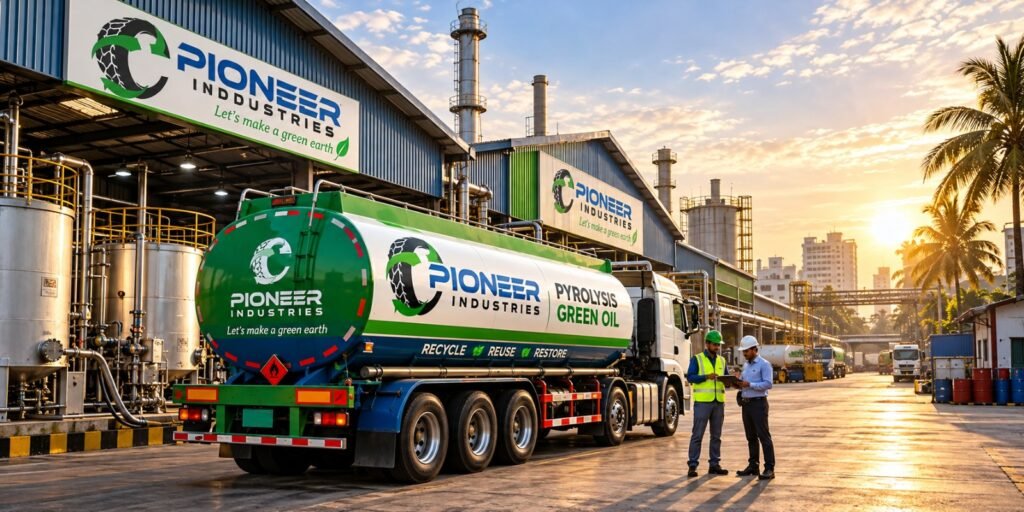
- Pyrolysis green oil is an alternative industrial fuel made from end-of-life tires through oxygen-free heating.
- Pioneer Green Oil has a typical calorific value of 10,400 ± 3% cal/g and sulphur of up to 1%.
- Typical uses include boilers, brick plants, steel workshops, glass units, power plants and hot mix plants.
- Potential savings of 5–10% against furnace oil and 25–30% against diesel are based on reference comparison.
- Check burner compatibility, test reports and local regulations before switching.
- Pioneer Industries Ltd supplies pyrolysis green oil from Dhaka, Bangladesh.
Conclusion
Pyrolysis green oil gives Bangladeshi industry a practical way to turn waste tires into usable fuel. With a typical calorific value of 10,400 ± 3% cal/g, low ash, low water content and sulphur of up to 1%, it is a credible furnace oil alternative for suitable boilers, kilns and furnaces. Success depends on checking equipment compatibility, reviewing test reports and running a trial first.
Ready to evaluate pyrolysis green oil for your plant?
Get a quote from Pioneer Industries Ltd,
call +880 1337 445522
Email – pioneer.greenoil@gmail.com.
Frequently Asked Questions
What is pyrolysis green oil used for?
Pyrolysis green oil is used as an industrial thermal fuel. In Bangladesh, suitable applications include boilers, brick plants, steel workshops, glass units, power plants and hot mix plants. Buyers should confirm burner and equipment compatibility and review the latest test report before switching from furnace oil or diesel.
Is pyrolysis green oil the same as diesel?
No. Pyrolysis green oil is a different fuel from diesel. It is made from waste tires rather than crude oil refining. Pioneer Green Oil has a density of 0.87–0.93 g/cc and a calorific value of about 10,400 cal/g, compared with a reference diesel value of about 10,600 cal/g.
How much sulphur does pyrolysis green oil contain?
Pioneer Green Oil contains up to 1% sulphur by weight, based on its product specification. In the reference comparison, furnace oil contains up to 4% and diesel up to 1.8%. Lower sulphur can help reduce sulphur-related emissions and equipment corrosion, but actual results depend on your equipment and operating conditions.
Can pyrolysis green oil replace furnace oil in boilers?
In many cases, yes, but it depends on your equipment. Pyrolysis green oil is positioned as an alternative to furnace oil for suitable industrial applications. Check burner type, pump and heating requirements, and run a small trial first. Potential savings of 5–10% against furnace oil are based on reference comparison.
Is pyrolysis green oil environmentally friendly?
Not entirely. Pyrolysis green oil helps divert end-of-life tires from landfill and recovers energy, supporting a circular economy. However, it is still a combustion fuel and is not emission-free. Environmental performance depends on the production process, fuel quality, burner efficiency and compliance with local regulations.
Where can I buy pyrolysis green oil in Bangladesh?
You can buy pyrolysis green oil in Bangladesh from Pioneer Industries Ltd, a Dhaka-based producer at Kabbokos Tower, Kawran Bazar. Call +880 1337 445522 or email pioneer.greenoil@gmail.com to request specifications, a test report, pricing and a quotation for your plant.
