

Our Blog
Turning Waste Into Sustainable Energy & Value
Biomass Briquettes vs Coal: Cost, Heat Value and Emissions Compared for Bangladesh Industry
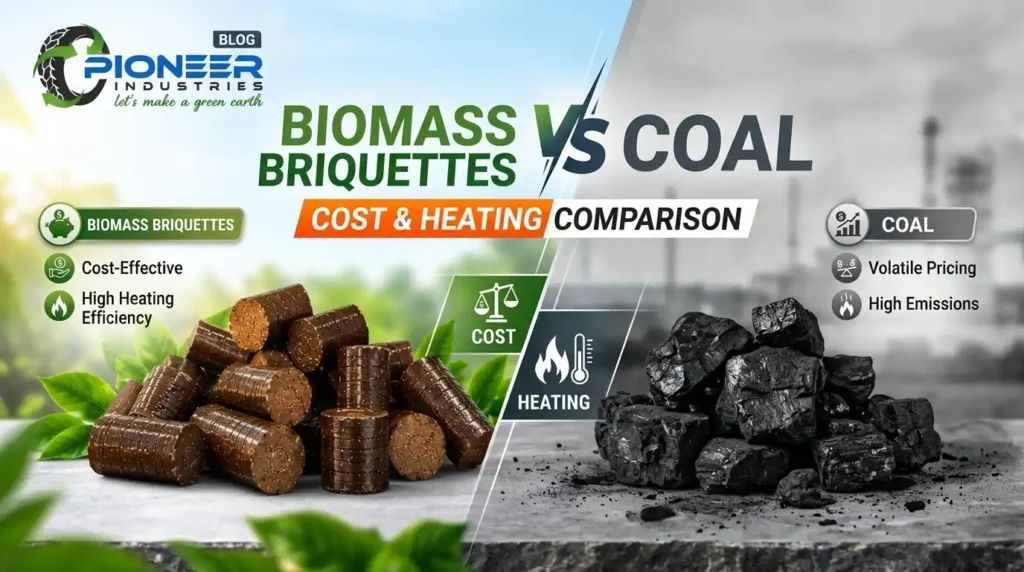
When comparing biomass briquettes vs coal, biomass briquettes offer a low-smoke, domestic alternative that significantly reduces sulphur and particulate emissions. Pioneer Industries Ltd produces high-density biomass briquettes from compressed agricultural and wood waste, enabling Bangladesh factories, brick kilns, and boiler operators to reduce fuel supply risks while complying with local environmental regulations.
Energy-intensive industries across Bangladesh depend heavily on solid thermal fuels to operate boilers, brick kilns, and high-temperature processing units. Traditionally, imported sub-bituminous coal has served as the primary solid fuel source. However, industrial plant managers face escalating operational challenges driven by volatile foreign exchange rates, high import freight costs, and tightening environmental standards set by the Department of Environment. Evaluating biomass briquettes vs coal provides plant engineers and procurement managers with a clear pathway to stabilize energy budgets while reducing carbon emissions. Pioneer Industries Ltd is a Dhaka-based eco-manufacturer of pyrolysis green oil, recovered carbon black, and biomass briquettes. In this comparative guide, you will learn how densified biomass fuel compares directly against industrial coal in cost stability, heat performance, combustion behavior, and regulatory compliance.

Understanding the Fundamentals: Biomass Briquettes vs Coal
Comparing biomass briquettes vs coal requires examining their raw origins, physical density, and chemical composition. Industrial coal is a fossil mineral extracted through underground or open-cast mining, containing variable amounts of carbon, moisture, volatile matter, ash, and sulphur.
Biomass briquettes are engineered bio-fuels created by mechanically densifying agricultural crop residues, sawdust, and wood waste under extreme pressure. Pioneer Industries Ltd processes locally sourced organic waste into uniform cylindrical blocks without using chemical binders. While raw biomass has low bulk density, mechanical compression creates a dense solid fuel that rivals conventional coal in structural handling, transport efficiency, and continuous furnace feeding.
Cost Comparison and Supply Chain Stability in Bangladesh
Evaluating the financial impact of biomass briquettes vs coal involves analyzing both raw fuel pricing and long-term supply predictability within the Bangladesh market. Industrial coal relies almost entirely on international trade routes, making local factory owners vulnerable to shipping delays, import tariffs, and global energy market spikes.
In contrast, biomass briquettes are manufactured domestically using abundant local agricultural and wood residues. By sourcing alternative solid fuel from a Bangladesh-based producer, factories eliminate currency conversion risks and long maritime lead times. Furthermore, the low ash content of processed briquettes minimizes slag accumulation inside furnaces, reducing manual boiler maintenance, downtime, and disposal costs.

Heat Value and Combustion Performance
Thermal performance is a key criterion for boiler engineers evaluating solid fuel upgrades. Industrial coal typically exhibits a gross calorific value ranging between 4,000 and 6,000 cal/g, depending on its grade and origin. High-density biomass briquettes deliver a competitive heat value that ensures consistent steam generation.
Fuel Parameter | Industrial Sub-Bituminous Coal | High-Density Biomass Briquettes |
Primary Origin | Imported Fossil Mineral | Compressed Local Agricultural/Wood Residue |
Combustion Profile | Heavy smoke, variable flame height | Low smoke, steady continuous flame |
Sulphur Content | High (typically 1.0% to 3.5%+) | Trace levels / negligible |
Ash Output | High (10% to 30%+ bottom/fly ash) | Low ash buildup |
Supply Source | Volatile international imports | Domestic Bangladesh supply chain |
Because biomass briquettes feature low uniform moisture levels, they ignite quickly and maintain a steady thermal output. Their consistent size and density allow for uniform combustion across furnace grates, eliminating cold spots commonly caused by irregular coal lumps or unrefined timber. For facilities operating liquid burners alongside solid grates, combining briquettes with Pioneer Green Oil offers a flexible dual-fuel strategy.

Environmental Emissions and Regulatory Compliance
Comparing the environmental footprint of biomass briquettes vs coal highlights major differences in air pollutant emissions. Burning coal releases significant amounts of sulphur dioxide (SO2), nitrogen oxides (NOx), and heavy fly ash into the atmosphere, contributing to smog and acid rain.
Biomass briquettes burn with significantly lower smoke emissions due to their low sulphur and nitrogen content. Furthermore, biomass fuel is carbon-neutral within its natural lifecycle, as the carbon dioxide (CO2) released during combustion equals the carbon absorbed by the plant material during its growth cycle. Transitioning to biomass briquettes helps factories fulfill local Department of Environment directives, pass environmental audits, and improve workplace safety for boiler technicians.
Applications Across Bangladesh's Manufacturing Sector
Biomass briquettes serve as an effective, drop-in alternative to coal and raw firewood across several key manufacturing sectors in Bangladesh:
- Textile & Garment Mills: Generating continuous process steam for fabric dyeing, washing, and finishing operations.
- Brick Kilns: Replacing raw firewood and high-sulphur coal to reduce stack smoke and comply with seasonal emission guidelines.
- Steel Workshops & Foundries: Providing steady pre-heating thermal energy for metal fabrication processes.
- Glass & Ceramic Facilities: Supplying uniform heat to maintain constant melting temperatures in refractory kilns.
- Food Processing Plants: Firing commercial drying and cooking units with clean, low-smoke thermal energy.
Manufacturers requiring high-performance industrial raw materials can also review our Recovered Carbon Black for rubber and industrial plastic manufacturing.

Conclusion
When evaluating biomass briquettes vs coal for industrial thermal applications, biomass fuel offers distinct advantages in emission control, supply security, and cost stability. Transitioning from imported coal to locally manufactured agricultural waste briquettes protects your facility from global market volatility while helping achieve national environmental standards. Pioneer Industries Ltd is a Dhaka-based eco-manufacturer of pyrolysis green oil, recovered carbon black, and biomass briquettes dedicated to powering Bangladesh industry sustainably. Ready to lower your boiler operating costs and emissions? Get a custom quote today by calling +880 1337 445522, emailing pioneer.greenoil@gmail.com, or reaching out through our contact page.
Frequently Asked Questions
What is the main difference between biomass briquettes vs coal?
The main difference between biomass briquettes vs coal lies in their source and emission profiles. Coal is an imported fossil fuel with high sulphur and ash content. Biomass briquettes are compressed from local agricultural and wood waste, burning cleaner with minimal smoke and lower sulphur emissions.
Can biomass briquettes replace coal in existing industrial boilers?
Yes, biomass briquettes can replace coal in most solid-fuel industrial boilers, brick kilns, and furnaces. Their uniform shape and density allow them to burn efficiently on standard grates without requiring extensive retrofitting or costly equipment modifications.
How do biomass briquettes help factories in Bangladesh cut costs?
Biomass briquettes lower energy costs by eliminating foreign exchange risks, import tariffs, and supply delays associated with imported coal. Additionally, their low ash content reduces boiler maintenance, furnace slagging, and ash disposal expenses.
Are biomass briquettes more environmentally friendly than coal?
Biomass briquettes are significantly cleaner than coal because they generate minimal sulphur emissions and lower particulate smoke. Because they are made from organic agricultural waste, they operate on a carbon-neutral cycle, helping factories pass local environmental audits.
Where can I buy biomass briquettes in Bangladesh?
Industrial buyers can source high-density biomass briquettes directly from Pioneer Industries Ltd. Located in Kawran Bazar, Dhaka, Pioneer Industries Ltd supplies verified alternative energy products to manufacturing plants, brick kilns, and boiler operators nationwide.
