

Our Blog
Turning Waste Into Sustainable Energy & Value

Recovered carbon black is a carbon-rich material recovered from end-of-life tires through pyrolysis, then milled and processed into a usable powder or pellet. It is used in rubber goods, plastics, pigments and other industrial products as a partial or full substitute for virgin carbon black, depending on grade and application.
Every year, large numbers of tires reach the end of their life in Bangladesh. Without proper recycling, they end up in landfills, open dumps or uncontrolled burning. Yet a scrap tire contains valuable carbon that can be recovered and reused.
Recovered carbon black turns that waste into a raw material for manufacturing. This guide explains what it is, how it is made from waste tires, how it differs from virgin carbon black, where it is used and what buyers should check before sourcing it. Pioneer Industries Ltd, a Dhaka-based eco-manufacturer, produces recovered carbon black alongside pyrolysis green oil and biomass briquettes.
What Is Recovered Carbon Black?
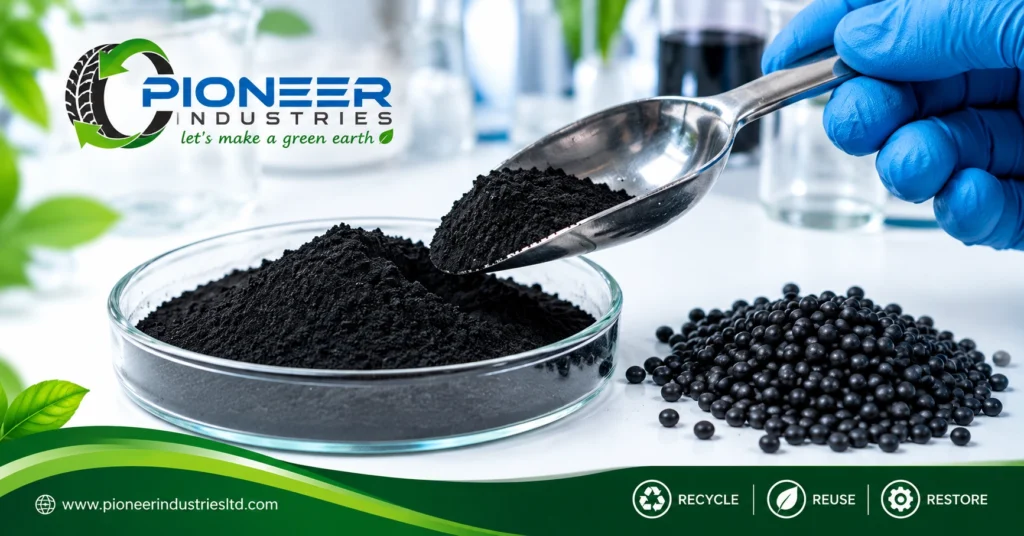
Recovered carbon black (often shortened to rCB) is the solid carbon material recovered from end-of-life tires during pyrolysis and then upgraded for industrial use. It is also called recovered carbon or tire-derived carbon black.
Pioneer Industries Ltd is a Dhaka-based eco-manufacturer of pyrolysis green oil, recovered carbon black and biomass briquettes. Its recovered carbon black comes from end-of-life tires and supports a circular materials model.
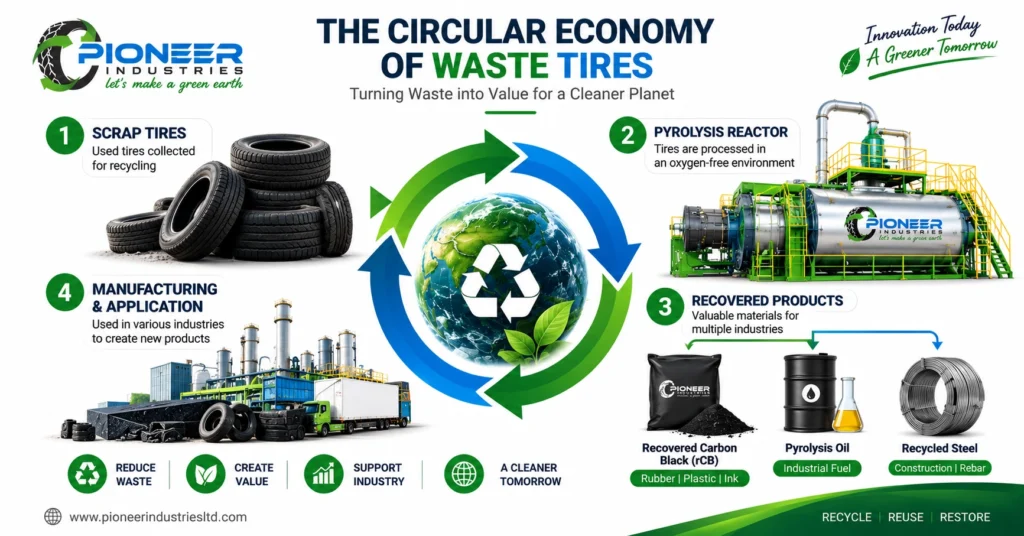
Tires are made from rubber, steel and a large share of carbon black filler that gives them strength and abrasion resistance. When a tire is pyrolysed, this carbon is left behind as a solid. After processing, it can return to manufacturing instead of being discarded.
How Is Recovered Carbon Black Made From Waste Tires?
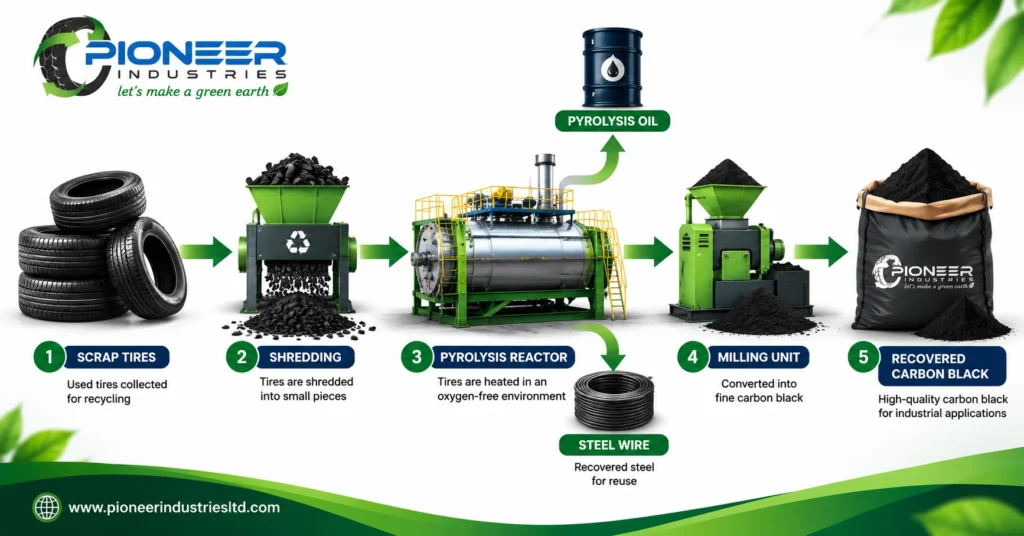
Recovered carbon black is made by heating shredded tires in an oxygen-free reactor, collecting the solid carbon that remains, and then purifying, milling and pelletising it. Pyrolysis breaks the rubber down without burning it.
The process generally follows these steps:
- Collection and preparation: end-of-life tires are collected, sorted and shredded.
- Pyrolysis: the material is heated in a sealed reactor with no oxygen. The rubber decomposes into vapour and a solid carbon-rich residue.
- Separation: steel wire is removed, and the solid residue is separated from the vapour stream.
- Co-products: the vapours are cooled into pyrolysis oil, and non-condensable gas can often be reused to help heat the process.
- Upgrading: the solid carbon is milled to reduce particle size, cleaned to remove contaminants and, where needed, pelletised for easier handling.
- Quality testing: batches are tested against the buyer’s required specification before supply.
Pioneer Industries describes its approach as closed-loop pyrolysis with green refining, designed to maximise material recovery. The same process that yields recovered carbon black also produces Pioneer Green Oil, an alternative fuel for suitable industrial thermal applications.
How Does Recovered Carbon Black Differ From Virgin Carbon Black?
Recovered carbon black is made from waste tires, while virgin carbon black is made from oil feedstock through a controlled combustion process. rCB can replace virgin carbon black in some applications but not all, because its properties depend on the tire feedstock and processing.
Factor | Recovered Carbon Black | Virgin Carbon Black
Source | End-of-life tires | Petroleum-based feedstock
Production route | Tire pyrolysis, then milling and upgrading | Controlled combustion of oil feedstock
Material consistency | Varies with feedstock; improves with controlled processing | Tightly controlled grades
Typical role | Partial or full replacement in suitable products | Standard filler for demanding applications
Waste benefit | Recovers material from end-of-life tires | None
Best fit | Cost-sensitive and non-critical rubber, plastics, pigments | Performance-critical products such as tire treads
Recovered carbon black often contains residual ash and mineral content from the original tire, and its particle characteristics can differ from virgin grades. [source: ASTM carbon black test methods or industry technical literature] For this reason, buyers should match the grade to the application and confirm results in a trial.
Where Is Recovered Carbon Black Used?
Recovered carbon black is used mainly as a reinforcing filler and colourant in rubber, plastics and other industrial products. The right use depends on the grade supplied and the performance your product requires.
Rubber Goods
Rubber products are the largest user category for carbon black. Recovered carbon black can be evaluated in products such as moulded rubber items, mats, hoses, belts and industrial rubber components, often blended with virgin carbon black. Pioneer Industries also supplies rubber granules from end-of-life tires.
Plastics and Masterbatch
Black plastic pipes, films, sheets and moulded items rely on carbon black for colour and UV protection. Recovered carbon black can be assessed for these uses, with particular attention to purity and dispersion.
Pigments, Inks and Coatings
Some formulations use carbon black as a black pigment. Suitability depends on particle size, purity and the finish required, so buyers should test small batches first.
Other Industrial Uses
Recovered carbon is also tested in construction materials, conductive and anti-static applications and other industrial formulations. These uses depend heavily on grade and testing. Request technical data before committing to volume.
What Are the Benefits of Recovered Carbon Black?
The main benefits of recovered carbon black are waste reduction, lower reliance on virgin material, local sourcing and potential cost advantages. These benefits are strongest when the grade is matched to the right application.
- Waste reduction: every tonne of tires processed is diverted from landfill and uncontrolled burning.
- Less virgin material: rCB reduces reliance on virgin carbon black in suitable products.
- Circular supply chain: material recovered in Bangladesh can return to Bangladeshi manufacturing.
- Potential cost advantage: depending on grade and market prices, rCB may offer lower material cost for suitable products. [NEED DATA: current price comparison]
- Co-product value: the same pyrolysis process yields oil and steel wire, improving overall resource recovery.
- Sustainability reporting: using recycled content can support customer and brand sustainability goals. [source: life cycle assessment or recycled content standard]
These are potential benefits, not guarantees. Actual results depend on grade, application and process control.
What Should Buyers Check Before Using Recovered Carbon Black?
Before using recovered carbon black, buyers should confirm the grade specification, batch consistency, handling needs and application performance. A simple checklist reduces risk.
- Specification sheet: request a datasheet covering ash content, moisture, particle size and other parameters your product requires. [source: ASTM carbon black test methods]
- Batch consistency: ask how the supplier controls variation between batches.
- Sample testing: test small batches in your own formulation before scaling up.
- Blend ratio: start with a partial replacement and increase only if performance holds.
- Dust handling: carbon black is a fine, dusty material. Use proper ventilation, dust control and protective equipment.
- Packaging and logistics: agree packaging type, volumes and delivery schedule in writing.
- Compliance: confirm that your use meets local environmental and product requirements in Bangladesh. [source: Department of Environment, Bangladesh]

Why Does Recovered Carbon Black Matter for Bangladesh?
Recovered carbon black matters for Bangladesh because it gives a growing tire waste stream a productive use and offers local manufacturers a domestic raw material option. It supports both waste management and industrial supply.
Bangladesh has a large and growing vehicle fleet, which means a steady stream of end-of-life tires. Without organised recycling, tires can pile up, collect water and become fire and pest hazards.
At the same time, rubber, plastics and industrial manufacturers need reliable, cost-effective raw materials. A locally produced material such as recovered carbon black can shorten supply chains and reduce dependence on imports for suitable applications. Pioneer Industries Ltd operates from Dhaka and supplies both industrial fuel and recovered materials from the same waste-to-value process. Plants that already use Pioneer Green Oil as a furnace oil alternative or biomass briquettes as a coal substitute can discuss all three products in one conversation.
- Recovered carbon black is solid carbon recovered from end-of-life tires through pyrolysis and then upgraded for industrial use.
- It is used in rubber goods, plastics, pigments and other products, often as a partial replacement for virgin carbon black.
- It differs from virgin carbon black in source, consistency and typical applications, so grade selection matters.
- Buyers should request a specification sheet, test samples and start with partial replacement.
- Pioneer Industries Ltd produces recovered carbon black, pyrolysis green oil and biomass briquettes in Dhaka, Bangladesh.
Recovered carbon black gives Bangladesh a practical way to turn end-of-life tires into a usable industrial raw material. It can support rubber, plastics and pigment applications, reduce reliance on virgin material and add value to the tire waste stream. Success depends on choosing the right grade, checking the specification and testing samples before scaling up.
Looking for recovered carbon black for your products? Get a quote from Pioneer Industries Ltd,
call +880 1337 445522 or
email pioneer.greenoil@gmail.com.
Frequently Asked Questions
What is recovered carbon black?
Recovered carbon black is solid carbon material recovered from end-of-life tires through pyrolysis, then milled and processed for industrial use. It is also called recovered carbon or rCB. It is used as a filler and colourant in rubber, plastics and other products, often as a partial replacement for virgin carbon black.
How is recovered carbon black made?
Recovered carbon black is made by shredding waste tires, heating them in an oxygen-free pyrolysis reactor and collecting the solid carbon residue. The residue is then separated from steel wire, milled, cleaned and sometimes pelletised. Pyrolysis also produces oil and gas as co-products.
Is recovered carbon black the same as virgin carbon black?
No. Virgin carbon black is made from petroleum-based feedstock under tightly controlled conditions, while recovered carbon black comes from waste tires. Recovered grades can contain more ash and vary more in properties, so they suit some applications better than others. Always test a sample first.
What is recovered carbon black used for?
Recovered carbon black is used mainly in rubber goods, plastics, pigments and other industrial products. Common examples include moulded rubber items, mats, hoses, belts and black plastic products. Suitability depends on the grade and the performance your product needs, so request technical data and test small batches.
Is recovered carbon black environmentally friendly?
Partly. Recovered carbon black diverts end-of-life tires from landfill and reduces reliance on virgin material, which supports a circular economy. However, pyrolysis is still an industrial process with energy use and emissions. Environmental performance depends on process control, energy sources and compliance with local regulations.
Where can I buy recovered carbon black in Bangladesh?
You can buy recovered carbon black in Bangladesh from Pioneer Industries Ltd, a Dhaka-based producer at Kabbokos Tower, Kawran Bazar. Call +880 1337 445522 or email pioneer.greenoil@gmail.com to request a specification sheet, samples, pricing and a quotation for your application.
