

Our Blog
Turning Waste Into Sustainable Energy & Value

Tire pyrolysis is a thermal decomposition process that breaks down scrap tires in an oxygen-free reactor at high temperatures. This thermo-chemical process converts waste rubber into high-energy pyrolysis green oil, recovered carbon black, steel wire, and combustible gas, providing a sustainable energy source for industrial boilers, kilns, and manufacturing facilities across Bangladesh.
Managing end-of-life vehicle tires poses a massive environmental and municipal challenge across Bangladesh. Millions of discarded rubber tires collect in landfills and open dumps annually, creating public health hazards and pest breeding grounds. However, modern resource-recovery technology turns this solid waste burden into a valuable industrial energy stream. Through thermal conversion, advanced facilities extract energy and industrial raw materials from discarded vulcanized rubber. Pioneer Industries Ltd is a Dhaka-based eco-manufacturer of pyrolysis green oil, recovered carbon black, and biomass briquettes. In this comprehensive B2B technical guide, you will explore how tire pyrolysis works, the high-value recovered outputs generated, and how Bangladesh industries leverage these alternative fuels to cut operational overhead.

What Is Tire Pyrolysis and How Does the Chemistry Work?
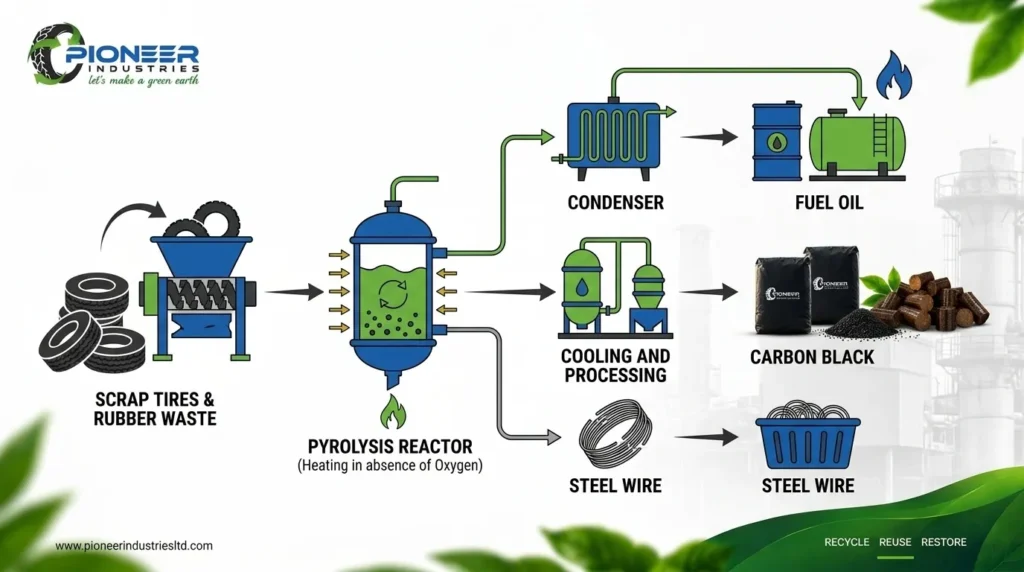
Tire pyrolysis is a thermochemical decomposition process that breaks down complex polymer chains in scrap rubber using extreme heat in the complete absence of oxygen. Because no oxygen is present inside the sealed reactor vessel, the rubber does not burn or catch fire.
Instead, the complex vulcanized rubber polymers break down into lower-molecular-weight vapors, liquids, and solid carbon residue. As the reactor heats up, volatile hydrocarbons evaporate from the solid rubber matrix. These gas vapors are channeled through multi-stage cooling condensers where they liquefy into high-grade fuel oil, leaving behind solid mineral matter and steel wire.
The Step-by-Step Tire Pyrolysis Process
The commercial thermal processing of end-of-life tires follows a controlled, multi-stage mechanical and thermal sequence designed to maximize energy yield and product purity.
Step 1: Pre-treatment and Shredding
Raw waste tires undergo inspection and mechanical de-beading to pull heavy rim steel. Mechanical shredders then reduce the bulky rubber into uniform chips, optimizing the surface area for uniform heat transfer inside the reactor.
Step 2: Oxygen-Free Thermal Reactor Heating
The prepared tire chips are fed into an airtight sealed rotary reactor vessel. External heating raises internal temperatures while nitrogen purging or vacuum seals maintain an oxygen-deprived environment.
Step 3: Condensation and Fractionation
Hydrocarbon vapors generated at high temperatures pass through multi-stage condensation columns. Liquid fractions condense into heavy oil, while non-condensable synthetic gas is recycled directly back into the furnace to fuel continuous heating.
Step 4: Solids Recovery and Discharging
After thermal processing completes, the reactor cools down. Solid materials—comprising crude carbon residue and embedded wire mesh—are extracted through magnetic separators to recover clean industrial steel and fine carbon powder.
Key Outputs Generated from Waste Tire Conversion
Recovered Product | Yield Percentage | Primary Industrial Application |
Pyrolysis Fuel Oil | ~40 – 45% | Industrial boilers, brick kilns, power units, steel workshops |
Recovered Carbon Black | ~30 – 35% | Rubber manufacturing, masterbatches, industrial pigments |
Recycled Steel Wire | ~10 – 15% | Steel rebar manufacturing and foundry remelting |
Synthetic Gas (Syn-Gas) | ~8 – 10% | Internal reactor combustion fuel (closed-loop energy) |
1. Pyrolysis Green Oil
This dark liquid fuel possesses a high heating value, making it an excellent alternative energy source for heavy industrial furnaces. Pioneer Industries Ltd produces high-performance Pioneer Green Oil with a verified calorific value of 10,400 ± 3% cal/g, sulphur content up to 1%, ash up to 0.05%, water content up to 0.25%, and a density of 0.87–0.93 g/cc at 15°C.
2. Recovered Carbon Black (rCB)
Recovered carbon black is extracted from end-of-life tires and milled into consistent particle grades. It serves as an economical filler and reinforcing agent used in rubber and industrial manufacturing, significantly reducing reliance on petroleum-derived virgin carbon black. Manufacturers can evaluate our high-grade Recovered Carbon Black for industrial application.
3. Recycled Steel Wire
High-tensile steel wire extracted during processing is cleaned of residual rubber particles and baled for supply to local steel re-rolling mills and foundries.

Industrial Applications in Bangladesh and Energy Economics
Factories and power generation facilities across Bangladesh face volatile imported fuel prices and frequent grid disruptions. Heavy industrial energy consumers—including textile processing mills, brick kilns, steel re-rolling workshops, glass factories, hot mix asphalt units, and power plants—require continuous thermal energy.
Utilizing pyrolysis-derived fuel oil delivers substantial financial advantages over conventional fossil petroleum. Based on reference comparisons, switching to pyrolysis oil offers potential savings of 5–10% compared to heavy furnace oil, and potential savings of 25–30% compared to industrial diesel fuel. These potential savings based on reference comparison help local plants stabilize energy overhead while maintaining high burner efficiency.
Additionally, energy managers seeking solid biomass fuel options for specialized furnaces can integrate our high-density Biomass Briquettes into their energy mix.

Environmental Compliance and Waste Mitigation Benefits
Discarded rubber tires do not decompose naturally. Open burning releases hazardous particulate matter and toxic air pollutants into the atmosphere, while open stockpiles harbor disease vectors and cause severe fire hazards.
Modern tire pyrolysis operates within a controlled, closed-loop thermal recovery system. By processing scrap tires inside sealed, negative-pressure reactors and utilizing multi-stage gas scrubbing, advanced facilities prevent runaway emissions. Converting solid waste tires into clean industrial fuel turns a major environmental liability into a sustainable domestic resource for Bangladesh’s growing economy.
Adopting thermal waste-to-energy recovery enables Bangladesh manufacturing enterprises to reduce fuel expenditures while meeting environmental expectations. By converting discarded rubber into high-calorific liquid fuel and recovered carbon, modern tire pyrolysis supports a cleaner, self-reliant industrial supply chain. Pioneer Industries Ltd is a Dhaka-based eco-manufacturer of pyrolysis green oil, recovered carbon black, and biomass briquettes, committed to delivering verified quality and consistent supply to industrial buyers nationwide. To request technical product specifications or obtain a competitive custom quote for your plant, call +880 1337 445522, email pioneer.greenoil@gmail.com, or submit your inquiry through our contact page.
Frequently Asked Questions
What is tire pyrolysis?
Tire pyrolysis is a thermochemical recycling process that heats scrap tires in an oxygen-deprived reactor. This process breaks down rubber polymers into high-value raw materials and energy products, including liquid pyrolysis green oil, recovered carbon black, steel wire, and combustible synthetic gas.
What are the fuel specifications of pyrolysis green oil?
Pioneer Industries Ltd produces pyrolysis green oil with a calorific value of 10,400 ± 3% cal/g, sulphur content up to 1%, ash up to 0.05%, water content up to 0.25%, and a density ranging between 0.87 and 0.93 g/cc at 15°C.
Which industries in Bangladesh use fuel from tire pyrolysis?
Pyrolysis green oil is widely used as a direct burner fuel in industrial boilers, brick plants, steel re-rolling workshops, glass units, power generation plants, and hot mix asphalt plants across Bangladesh seeking efficient, cost-effective heat energy.
How much money can a factory save by switching to pyrolysis oil?
Based on reference comparisons, industrial facilities switching to pyrolysis green oil can achieve potential savings of 5–10% compared to conventional heavy furnace oil, and potential savings of 25–30% compared to standard industrial diesel fuel.
What is recovered carbon black used for?
Recovered carbon black (rCB) extracted during tire pyrolysis is utilized as a sustainable reinforcing filler, pigment, and chemical compound in rubber manufacturing, masterbatch production, and industrial plastic products, reducing reliance on virgin petroleum carbon.
How does tire pyrolysis help the environment in Bangladesh?
Tire pyrolysis redirects end-of-life tires away from landfills and illegal fire dumps. By converting solid waste into refined alternative fuel within sealed industrial reactors, it reduces municipal pollution while supplying local factories with sustainable domestic energy.
